
Countless people over the world rely on sorghum and various millets for sustenance. Some common millets include Pearl millet, Finger millet, Kodo millet, Proso millet, Foxtail millet, Little millet, and Barnyard millet. These are typically rain-fed crops grown in arid regions, and as such, their significance for long-term agriculture and food security has increased. In most poor nations, people eat almost all millets, whereas in wealthy nations, their main purpose has been as animal feed.
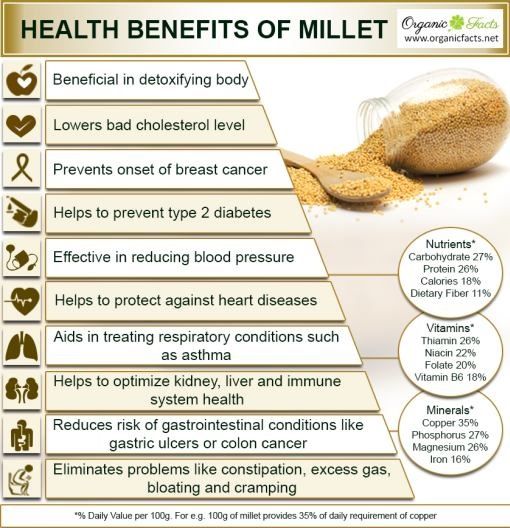
In terms of protein, micronutrients, and phytochemical content, millets are on par with other main cereals. The anti-oxidant content and activity are affected by the processing procedures used (Saleh et al., 2013).
Finger millet has 12-16% protein and 2-5% lipids, while sorghum and most millets only have 10% protein and 3.5% lipids. Micronutrients, such as vitamins and minerals, can be found in high concentrations in sorghum and millets. While the amino acid profile of millets is superior, the major component of sorghum protein, prolamin (kaffirin), has the opposite effect when cooked.
Proteins in cooked sorghum are said to be much less digestible than those in other cereals; this may be advantageous for some people’s diets. However, the millet protein is more easily digested than wheat protein because it contains fewer cross-linked prolamins.
Finger millet contains between 5% and 8% protein, 65% carbs, 20% fibre, and 2.5% to 3.5% minerals, according to a 2007 study by Chethan and Malleshi. Traditional foods like roti, muddle, and ambali (thin porridge) typically call for the Naked caryopsis of finger millet, which has a brick red coloured seed coat. Epidemiological studies have indicated that reducing your risk of type 2 diabetes mellitus, gastrointestinal disorders, and cardiovascular hazards can be as simple as eating more whole grain cereals and their products on a regular basis (McKeown, 2002).
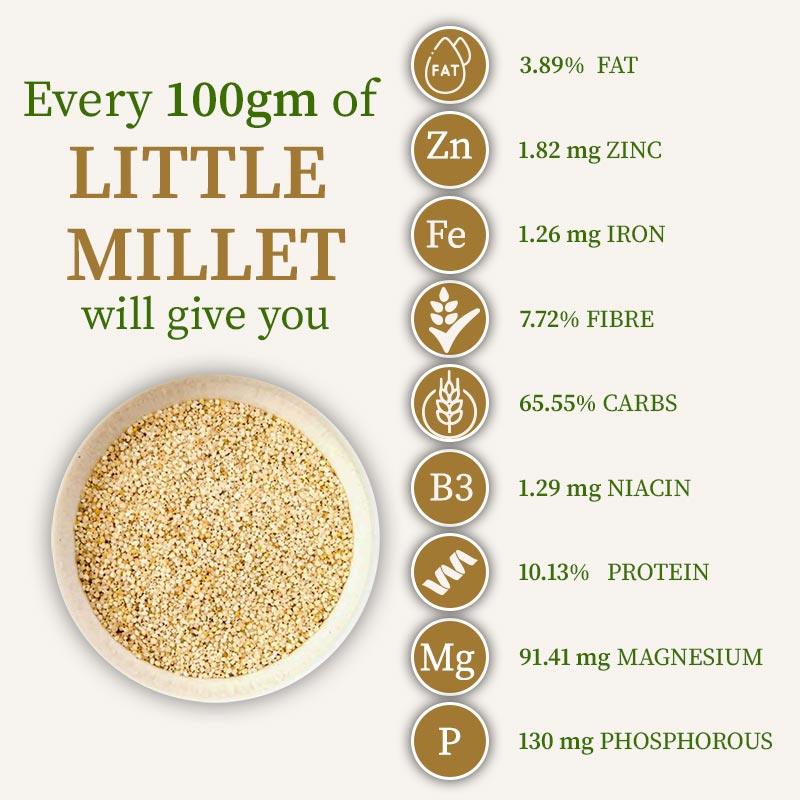
The nutritional and health benefits of millets come from the fact that their outer layer, or seed coat, is where many of the grain’s key elements, like dietary fibre, minerals, phenolics, and vitamins, are concentrated (Antony et al., 1996).
In terms of nutrients, millets are on par with other main grains. They are also an excellent source of carbs, vitamins, and phytochemicals with nutritional characteristics. Protein makes about 7-12% of the millets, fat makes up 2%, carbs make up 65-75%, and dietary fibre makes up 15% or so.
Pearl millet has a higher protein content (12-16%) and lower fat content (1.5-2%), while finger millet has lower protein (6-8%) and fat content (1.5-2%). Millet protein has an improved profile of essential amino acids compared to that of maize. Pearl millet has the highest niacin concentration of any cereal grain, whereas finger millet proteins are unlike any other due to their unusually high sulphur-rich amino acid content.
Millet proteins, like cereal proteins, are low in the amino acid lysine, but when combined with vegetable (leguminous) and animal proteins that are rich in lysine, they form nutritionally balanced composites with a high biological value. In comparison to refined cereals, small millets have a higher nutrient density. In comparison to other small millets, finger millet has the highest concentration of calcium (300-350 mg/100 g), and it is also a good source of phosphorus and iron.
| FUNCTION | HEALTH CONSEQUENCES | MILLET |
| Water absorbing and bulking property | Energy diluents to formulate low calorie diets | All Millets |
| Increased transit time of food in the gut | Reduced risk of inflammatory bowel disease | Sorghum and Finger Millet |
| Bile acid and steroid binding | Hypocholestero-laemic activity and reducing the risk of cardiovascular diseases | Pearl Millet, Sorghum and Finger Millet |
| Retardation of carbohydrate absorption and impaired glucose tolerance | Management of certain type of diabetes | Sorghum, Pearl Millet and Finger Millet |
| Binding of toxins | As a detoxifying agent | Sorghum |
| Binding of divalent cations | Reduced bioavailability of Ca, Mg, Zn, Fe | Proso Millet and Foxtail Millet (unprocessed) |