
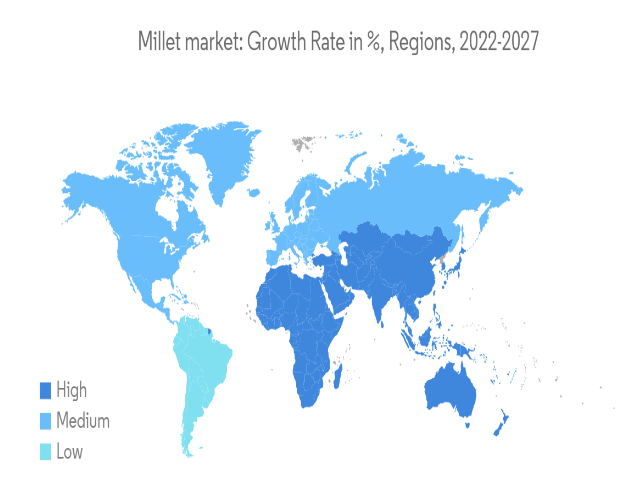
North America, Europe, Asia-Pacific, South America, and Africa are the geographical subsets of the Millet Market. Price Trend Analysis, Export Analysis, Import Analysis, Consumption Analysis, and Export Analysis are all covered in the report’s depth. Market value is provided in terms of US dollars, and market volume is provided in terms of metric tonnes.
Important Details
- Sorghum, finger millet, pearl millet, barnyard millet, proso millet, and tiny millet are all examples of millets. Over 32 million acres of land are dedicated to its cultivation in dry, semiarid, and sub-humid regions of the world. More than 55.0% of worldwide millet production comes from just three countries: India, Niger, and China. Millet is grown in vast quantities in India. Millet production in Africa has expanded considerably in recent years as many countries promote dryland agriculture due to low water availability and sub-tropical climatic conditions that are conducive to millet production.
- Vegetarians and vegans across the Americas, Europe, and Asia-Pacific will appreciate these grains for their high protein content. In addition, the pandemic has had a beneficial effect on the market since more people are eating millets and switching from junk food to millets and their derivatives in an effort to strengthen their immune systems and improve their overall health. Since millet-based goods are becoming increasingly popular in these areas, the millet market is expected to continue expanding.
Market Tendencies for Millet
India is the world’s leading producer.
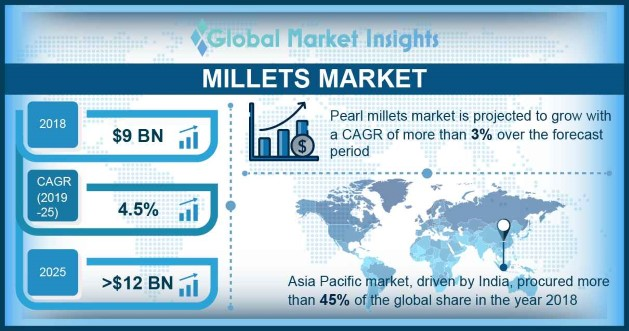
- In India, millet production is encouraged by the government and non-profits because of the grain’s usefulness in constructing balanced meals. The Government of India recognises millets as Nutri-Cereals due to their high nutritional value. In addition, the National Food Security Mission has a sub-mission on nutri-cereals that the Department of Agriculture and Farmers’ Welfare (DA&FW) is executing to increase millets’ acreage, production, and productivity.
- The FAO predicts that global millet production will rise from its 2019 forecast of 28.33 million metric tonnes to 30.08 million metric tonnes in 2021. It is estimated that by 2021, India will have cultivated 43.0% of the world’s sorghum, jowar, pearl millet, finger millet, and other minor millets. Millet output in India has climbed from 14.52 million tonnes in 2015-16 to an expected 17.96 million metric tonnes in 2020-21, as reported by the Ministry of Agriculture and Farmers Welfare.
- Millet exports have increased as a result of increased domestic output. Exports of millet from India increased by 8% in 2021-22, reaching 159,332.16 metric tonnes from 147,501.08 metric tonnes in 2020-21. This is expected to stimulate domestic millet production. In addition, the Indian government is encouraging millet exports to meet expanding global demand.
- In order to boost exports of millet, APEDA has prepared 16 programmes to promote millets and millet products in markets like the United Arab Emirates, Indonesia, the United States, Japan, the United Kingdom, Germany, South Africa, Australia, Saudi Arabia, and so on. Therefore, the market is expected to be driven in the next years by the increasing demand for millets on the worldwide market and the growing local production in India.
Africa is the world’s consumption leader.
- Production and consumption of millet are highest in Africa. More than half of the world’s output comes from this area, with Asia coming in second at 40%. More than 40 percent of the world’s millet is consumed in Africa, specifically in the countries of Niger, Mali, Nigeria, Burkina Faso, and Sudan.
- Where food and nutritional security are major issues, especially in India and Africa, millets are common. The crop is highly productive in semi-arid regions of Africa because of its strong drought tolerance capabilities. So, people are working to increase millet farming as a response to climate change and food insecurity.
- African governments established millet policies in May 2021, encouraging local seed banks, seed fairs, and farmer networks to increase millet production and consumption. The development and production of millet seed is the only focus of public and commercial investments.
- Millets’ international prices fluctuate widely based on supply volumes and tend to be unconnected to those of other main coarse grains. Consequently, as climate change and food insecurity become more pressing concerns in the region. The millet market is being driven by rising expectations for production and consumption of millet in Africa.
Millet Market News
- The Indian government devised a five-year strategy to promote millet in the foreign market in the month of November, 2022. In order to enhance domestic export millets internationally, the plan calls for the participation of Indian embassies overseas and global retail supermarkets like Carrefour, Walmart, Al Ruya, Lulu Group, etc.
- The state government of Orissa approved the second phase of the ‘Odisha Millet Mission’ in April 2022, with a budget of over USD 340 million to be spent over the course of six years to revitalise millet production in the state. The project’s overall objective is to boost millet production in 19 of the state’s administrative divisions.
- Wholsum food, an Indian startup based in Gurugram that makes food from millet, has raised over USD 7.0 million in funding as of February 2022. The capital is being used to broaden the company’s reach in terms of product development, advertising, and distribution.